
When your student is ready to enter high school, it is important to begin to establish goals in order to create an academic and extracurricular activity plan that meets their future needs. If higher education of some kind is in that educational plan, then these goals should be based on the type of college your child plans to attend.
Plan for College Admissions
Public high schools usually have more than one option when it comes to diplomas – – there is no reason that homeschoolers can’t too! Options include a standard diploma, college preparatory diploma, technical diploma, career preparatory diploma, special education diploma, and a certificate of achievement. For the sake of this discussion, we are speaking of a “diploma”, not as the paper achievement certificate received at graduation, but rather as a specific track that a student chooses to follow based on his or her educational goals.
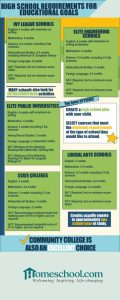
Choosing a specific educational track will help you decide which courses to take during high school. When creating a high school plan with your child, it is essential that you select courses that will at least meet the minimum requirements of the type of college or university your child is interested in applying to. Click image below for a guide to College Admissions Requirements.
Keep in mind that the above guide does not include extracurricular activities, which many colleges and universities also look for. While no one activity is held above another, each needs to demonstrate your commitment, sense of community, or leadership skills. While not listed on the above table of educational requirements, community colleges are also an excellent choice for continuing your student’s education. Most community colleges are open enrollment, which means that students need only to meet the minimum age requirement and possess a diploma or GED. However, many specific academic programs within community colleges, such as nursing, allied health, law enforcement, engineering, or computer technology may have additional high school credit requirements for applicants. It’s important to research the requirements of the specific academic program the student is interested in.
In addition, Ivy League and elite institutions of higher learning also examine high school transcripts to see if high schoolers have chosen more rigorous courses of study. In addition to checking for credit counts by subject, they also want to see that students have challenged themselves by selecting honors-level, or advanced placement courses when available. The Homeschool.com Resource Guide can be helpful in this area. The directory offers the ability to search for curriculum by subject AND course level as well as many other filters.
Plan Your College Finances
It is true that paying for a college degree is not easy. Many students take the easy way out and apply for all the student loans that the government makes easy to get. However, in doing so – the student seals their future for at least the next decade or two. Many adults are still paying for college at the age of 50! That’s not the bright future that college graduates look forward to.
There are many free tools that high school students can use to enable them to plan for college and get the help they need to make it through on a tight budget. Create a DIY College Road Map! You can log in and add your information, degree, etc. It will help you develop a plan and stick to it!
First Steps to a Debt-Free College Education
- Participate in SAT/ACT/CLT prep and take the SAT/ACT several times to score in the “state scholarship” range
- Apply for the FAFSA – everyone needs to do this not just those in financial need.
- Apply for College Scholarships now.
Plan Your Junior Year College Prep
The fall of your student’s junior year is a good time to take the PSAT (Preliminary Scholastic Aptitude Test). The test – also known as the NMSQT (National Merit Scholarship Qualifying Test) – serves as both a “practice” for the SAT and as a means of assessing your student’s chances at qualifying for the National Merit Scholarship.
Homeschooled students can start earning college credit while still in high school. The three ways students usually do this are:
Sometimes, students do a combination of these and take some AP classes and some Dual Enrollment courses. Other times, students prefer to stick to one path. What your student does is up to your family but there is no “right” or “wrong” way to go about doing it. In some states, students must be enrolled as a homeschooler through the county for the last two years to qualify for Dual Enrollment. If your student is interested in Dual Enrollment, it would be a good idea to look into your state’s requirements.
This is also a great time for your student to start making a college list. He or she can determine which schools are under consideration and start scheduling tours of college campuses. Additionally, your student will want to create a testing plan. Will your student take the SAT or the ACT? Perhaps your student will take both. Is your student taking any AP courses? If so, the exams will be in May and you can contact College Board to find out how and where your student can take the tests. Homeschooled students need to make arrangements for all of these tests on their own. Creating a testing plan during your student’s junior year provides ample time to address all the necessary tests.
Winter is a great time for your student to narrow down college choices and organize necessary information. It would be a good idea for your student to dedicate a drawer or filing cabinet specifically for college information. There, your student can keep track of college brochures and copies of applications, as well as grade records and transcripts. This would also be a good place for your student to store scholarship applications and information needed for financial aid. If your student is filling out the FAFSA (Free Application for Federal Student Aid), for instance, he or she will need your tax information so keeping a copy in this drawer will prove to come in handy.
By the time spring rolls around, your student is nearly finished with junior year! The hustle doesn’t stop there, though. In some ways, it’s just beginning. For example, scholarship searches take place this time of year. Applying for many scholarships as often as you can is a good rule of thumb.
The spring of junior year also makes a good time to create your student’s senior year schedule. Many states have graduation requirements your student may need to fulfill. While homeschoolers are usually not bound to this requirement, you also don’t want your student placed at a disadvantage against others. For this reason, it’s a good idea to meet or exceed what he or she would take in public school.
Plan Your Senior Year
What an exciting time! With the whole summer off, your student can pack a lot into this final summer starting with college tours. The schools your student chose to visit back in the fall will likely welcome a summer tour.
Start your student’s senior year off with a bang by finalizing the list of colleges and registering for the SAT or the ACT! Of course, your student will certainly want to stay on track academically for the remainder of the year. It’s tempting for students – especially those who’ve already been accepted into college – to slack off senior year.
This is also a good time of year to start requesting letters of recommendation for college admission. Depending on the school your student hopes to attend and the program of interest, the number of letters can vary. In most cases, schools want two letters but some only want one and others want three. It’s important to find out exactly what the school your student is interested in wants and then seek to obtain those.
Winter of your student’s senior year makes for a great time to take advantage of any early acceptance letters. If your student already knows which school he or she will attend, feel free to start filling out the FAFSA. The school will have a 6-digit FAFSA code you’ll need, and this information is often found at the school’s financial aid website. Students can start as early as the October prior to their first year of college to apply for the FAFSA.
Finally, in the Spring of your student’s senior year, you’ll want to make sure all tests both college entrance and any dual enrollment, AP, or CLEP tests are complete and you are wrapping up that amazing transcript!
Plan for the College Entrance Essay
One of the most stressful parts of getting your high schooler college ready is the application or admission process. Many colleges require a college entrance essay and for some students, this can be a challenge. We’ve pulled together all of the best tips and advice from college admissions specialists as well as our own experience with our homeschool students entering college. Our Guide to College Entrance Essays is a perfect place to start.